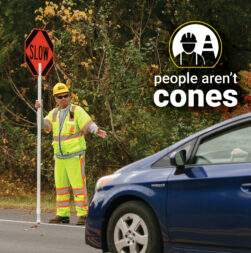
When people think about work zones, they usually picture long-term highway construction. Cones. Barriers. Flashing lights. What many motorists don’t picture are crews working in live traffic on the roads they drive every day.
Many of the most dangerous work zones are the ones people don’t picture or expect. They’re temporary. They’re on familiar streets in residential neighborhoods, on two-lane rural routes, or along roads motorists travel every single day as they commute to work, school, and daily activities. And because they don’t match the mental picture most people have of a “work zone,” they’re often where attention drops, and risk rises. If you’re behind the wheel, that matters. When drivers don’t expect a work zone, they react too late, and that is when people get hurt.
At Flagger Force, short-term traffic control is where safety matters most. That belief is at the heart of our People Aren’t ConesSM campaign, an effort to reinforce that work zones don’t just contain equipment. They contain people doing critical work in real time. We refuse to let our people blend in with equipment. That is why our crews wear full-body, high-visibility yellow PPE. It clearly distinguishes people from orange devices. But PPE and training alone aren’t enough. Preventing work zone crashes starts with drivers recognizing that real people are working just feet from live traffic.
Short-Term Work Zones Present Unique Risks
Unlike major highway construction, short-term and temporary work zones rarely have the benefit of positive protection, such as concrete barriers. Crews rely on training, visibility, and situational awareness to operate safely, often while fully exposed to live traffic. In these environments, channelizing devices like cones help guide drivers, but they don’t physically separate people from vehicles. That distinction matters, because cones don’t get hurt. People do.
“People assume short-term work zones are easier or safer because they’re smaller,” said Del Haines, Safety Professional at Flagger Force. “But we’re often standing out in the open, relying on training and awareness instead of barriers.”
Truck Mounted Attenuators (TMAs) are designed to absorb impact when a vehicle is struck, adding protection during some phases of work. But they aren’t always present once crews are actively working in the roadway. (Requirements for TMA usage vary by state, adding another layer of complexity for crews working across multiple markets.)
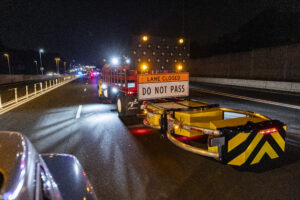
The result is a type of work zone where human decision-making, not just equipment, plays a critical role in keeping everyone safe.
The Most Dangerous Moments Happen Before Drivers Slow Down
While we often think about what happens inside a work zone, some of the most hazardous moments for traffic control professionals occur before motorists even realize one is there, when crews are actively setting up or removing the temporary work zone.
Set-up and tear-down consistently pose the highest risk to traffic control professionals, because crews are in the roadway before drivers realize conditions have changed.
“We know that setup and removal are when our crews are most exposed,” said Matt Craley, Associate Vice President of Risk and Safety at Flagger Force. “That’s why our process separates responsibilities. One person focuses on controlling traffic, while another focuses on the task of setting up or tearing down the work zone.”
That separation isn’t universal across the industry, but it’s essential. Asking someone to manage traffic while placing signs or devices divides attention at the exact moment it’s needed most: when conditions are still in transition, and driver behavior is unpredictable.
The risks only intensify as the environment changes. In rural areas, limited shoulders, guardrails that eliminate escape routes, and long stretches of road where drivers don’t expect to encounter people all add to the danger. In residential areas, the risks change. Driveways. Pedestrians. Cyclists. Curves in the road. Unpredictable movement. The environment is constantly shifting.
Familiar Roads Can Create Dangerous Complacency
Ironically, the roads drivers know best are often the ones where they pay the least attention. “When people drive the same route every day, they get comfortable,” Del explained. “They go on autopilot.”
That familiarity leads to distraction, phones, and complacency behind the wheel. Drivers may miss signs, ignore stop/slow paddles, or assume traffic control doesn’t apply to them. Matt shared that in some cases, drivers will even attempt to bypass flaggers during active setup, prioritizing their schedule over safety. “When drivers don’t expect a work zone, they’re less prepared to react,” he said. “That’s when situations escalate quickly.”
In contrast, drivers navigating unfamiliar roads often remain more alert, watching for cues and adjusting behavior accordingly. It’s a reminder that awareness isn’t automatic. It’s a choice.
What Situational Awareness Really Means in a Work Zone
In short-term work zones, situational awareness is a skill that crews practice constantly. For traffic control professionals, it means keeping your head on a swivel, monitoring traffic flow, watching side streets and driveways, tracking pedestrian movement, and always knowing where your escape route is.
“It’s about thinking through every move before you make it,” Matt said. “Even something as simple as opening a truck door, you need to pause and check your surroundings first.” Del added that situational awareness extends beyond vehicles. Surface conditions, weather, visibility, and unexpected movement all factor into how crews position themselves and respond in real time.
This level of awareness allows crews to react quickly when something goes wrong, whether it’s a distracted driver, a sudden pedestrian, or an errant vehicle entering the work zone.
Why Professional Traffic Control Matters
On most construction sites, the presence of traffic control professionals creates clear direction for drivers and can be the difference between a controlled work zone and a dangerous situation. Without trained flaggers, drivers are left to “figure it out themselves,” often leading to confusion, near-misses, or worse. Clients have shared firsthand experiences of close calls and injuries that occurred when traffic control wasn’t properly in place.
“That’s why our clients rely on us,” Del said. “We don’t cut corners. If something is required for safety, we do it, every time.” That consistency builds trust, not just with clients, but with the communities where work is taking place, and Flagger Force is proud to say that when it comes to safety, we’ve got your back. Every time.
The Critical Things You as a Driver Can Do to Make a Difference
If there’s one message Flagger Force wants every driver to take away, it’s simple: stay alert. Put the phone down, remove distractions, and pay attention.
Short-term work zones may only be temporary. A single distracted decision can change someone’s life in a second. Matt noted, “Work zones require your full attention. Even brief distractions can have serious consequences when people are working just feet from live traffic.”
At Flagger Force, being Safety-Driven® means planning for the work zones people don’t expect, preparing for the moments when attention drops, and never losing sight of what’s at stake. It means protecting our employees, our clients, and the motorists who travel through our work zones every day, so the people working in our roadways can return to their families at the end of the day.