
At 65 miles per hour, a vehicle travels approximately 95 feet per second. That means in the time it takes a driver to glance at a phone, adjust the radio, or look away from the roadway, their vehicle has covered nearly the length of a basketball court. It’s a powerful reminder that every second matters in a work zone.
At Flagger Force, we are Safety-Driven® and committed to ensuring our crew members, clients, motorists, and community members return home safely at the end of every day. Through education, advocacy, and partnerships with organizations that share our safety-focused mindset, we work to strengthen work zone protections across the communities we serve.
Each year, Flagger Force recognizes National Work Zone Awareness Week (NWZAW), a national campaign held at the start of road construction season to encourage safe driving through work zones and honor the roadway personnel who assume the risks each day to support projects and protect the crews improving our nation’s infrastructure. While NWZAW takes place during a single week in April, its message extends far beyond those five days: work zone safety requires vigilance, visibility, and shared responsibility year-round.
As part of our ongoing efforts to strengthen work zone safety—and reinforce the message behind our People Aren’t ConesSM campaign, which reminds drivers that roadway workers are human beings, not replaceable equipment—we recently connected with representatives from Plasticade, an industry-leading manufacturer of temporary traffic control devices that shares our commitment to advancing safety through innovation and industry leadership.
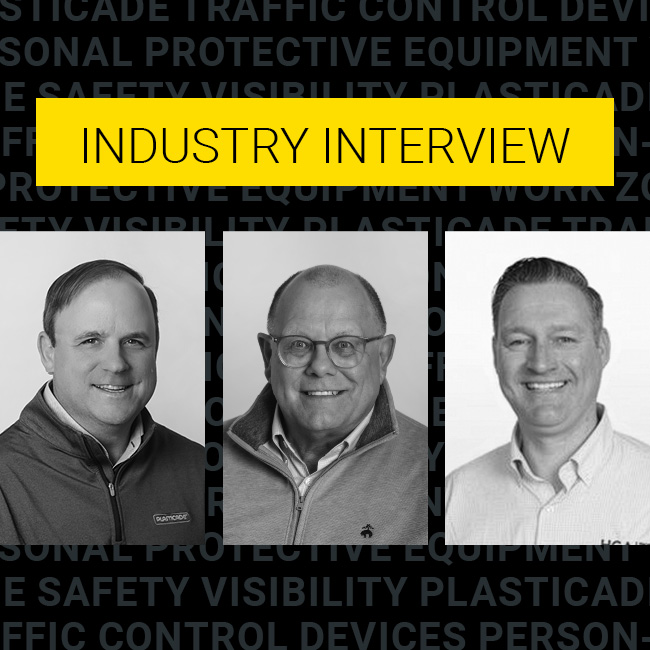
We were honored to speak with Charles Frick, East Regional Manager; Brook Jerzyk, Director of Market and Business Development; and Jeremy Karns, Director of Sales for Harvey Gerstman Associates, Plasticade’s Mid-Atlantic representative agency. Together, they shared insights into how work zone safety has evolved, why visibility is critical in both low-light and high-speed environments, and how collaboration between manufacturers and traffic control providers can help protect the people working inside the zone.
Read what Charles, Brook, and Jeremy shared during our recent conversation.
Can you share your role at Plasticade and provide an overview of the company?
Charles: I serve as the East Regional Manager for Plasticade, covering 18 states. I work closely with our independent sales representatives, supporting pricing, training, and customer needs in the field. Our goal is to be a true extension of our customers’ teams. We don’t just want to sell products. We want to serve as a resource.
Plasticade specializes in temporary traffic control devices used across the country to support roadway safety. The company’s core products include traffic cones, drums, 42-inch channelizers, and vertical panels, devices commonly seen in work zones nationwide. In addition to those foundational products, Plasticade also offers roll-up signs and stands, ADA-focused devices, and water-filled barrier systems designed for crowd control and enhanced work zone protection.
Jeremy: As Director of Sales for Harvey Gerstman Associates, I represent Plasticade throughout the Mid-Atlantic. My role is to ensure companies understand which products are available, what’s new, and what might work best for their specific work environments. If something isn’t working in the field, we help evaluate and adjust. That communication goes both ways—we bring feedback back to the manufacturer so products can continue to improve.
Brook: I serve as Director of Market and Business Development. Much of my career has involved standards and regulatory development, including work with ASTM committees and advisory groups tied to the Manual on Uniform Traffic Control Devices (MUTCD). That experience shapes how we approach product design. We’re always looking at what the standards require, what’s changing, and how technology can better serve the needs of the roadway worker.
How has work zone safety evolved in recent years?
Charles: One of the biggest changes has been the adoption of updated crash-testing criteria under the Manual for Assessing Safety Hardware (MASH). These standards increased the severity of testing and adjusted vehicle weights to better reflect modern traffic conditions. As a manufacturer, we had to evolve with those changes. Virtually all our devices are MASH tested and compliant. When standards change, the industry must change with them.
Brook: Another significant shift has been the growth of nighttime work zones. Ten years ago, nighttime traffic control was less common. Today, it’s routine. That changes visibility needs, driver behavior, and worker exposure. Drivers at night face different risk factors than during the day: fatigue, distraction, and impairment all become more prevalent.
When you travel at 65 miles per hour, you cover approximately 95 feet per second. Recognition distance and stopping sight distance become critical. A driver needs time to see the work zone, process what’s happening, and take action. That’s why advanced warning signs, proper taper lengths, and device spacing matter so much. The goal is to move motorists where they need to be before they reach the active work area.
We’re also seeing changes outside the work zone that affect safety inside it. Vehicles are getting taller. SUVs and pickup trucks have higher hood lines than vehicles did decades ago. Many temporary traffic control devices were originally modeled around smaller vehicle profiles. As the automotive fleet changes, the industry has to continually evaluate whether device height and placement are optimized for visibility.


What traffic control devices are best suited for enhancing visibility in low-light or high-speed environments?
Charles: Device selection depends heavily on the environment. In high-speed corridors and nighttime applications, the visual footprint becomes extremely important. Some states now require larger drums instead of 42-inch channelizers at night because the larger presence improves driver recognition. Agencies are continuously evaluating specifications based on real-world conditions.
Brook: Recognition and stopping distance are critical. The earlier a driver understands they are approaching a work zone, the safer that transition will be.
Fluorescent materials, reflective sheeting, proper spacing, and taper design all contribute to that early recognition. It’s not just about placing devices—it’s about ensuring they are seen, understood, and respected.
At Flagger Force, we emphasize that roadway workers are real people. How does Plasticade design with the human factor in mind?
Brook: Wherever possible, we focus on creating positive protection—something between the motorist and the worker. Water-filled barrier systems and longitudinal channelizing devices can help create that separation.
It’s also important to remember that personal protective equipment (PPE) is your last line of defense. Temporary traffic control devices, proper setup, and driver awareness should prevent a vehicle from ever reaching the people working inside the zone. If PPE is the only safeguard remaining, the situation has already escalated.
Color contrast plays a critical role in visibility. Fluorescent yellow-green garments are intentionally selected because they contrast against the orange devices commonly used in work zones. Those non-natural colors stand out against most backgrounds and help ensure roadway workers remain highly visible in a variety of lighting conditions.


What does innovation look like at Plasticade? How has the company evolved alongside changes in safety regulations and standards?
Charles: Innovation starts with listening. We spend a lot of time talking with customers to understand what’s working in the field and what isn’t. Contractors and traffic control providers face real-world challenges every day—from faster deployment needs to equipment durability in high-speed environments. Our job is to respond to those needs while ensuring compliance with evolving standards.
We also stay closely connected to industry committees and regulatory discussions so we can anticipate changes rather than react to them. Innovation is not only about introducing something new—it’s about evolving alongside the standards that govern work zone safety.
Brook: Standards continue to change, whether through updates to the MASH, refinements to state specifications, or evolving expectations around nighttime visibility and device performance. Products must be tested, retested, and validated under real-world conditions.
For example, a tractor-trailer traveling at highway speeds creates significant wind force. Devices must remain stable, deflect appropriately, and perform consistently in those conditions. Durability and performance under stress are critical components of safety. Innovation means evaluating how products function in the environments where roadway workers depend on them.
Jeremy: The feedback loop between the field and the manufacturer is essential. When contractors identify transportation challenges, setup inefficiencies, or durability concerns, those conversations come back to Plasticade. One example is the Hydracade, a water-filled barrier system developed in response to customer demand for positive protection that could also be transported and deployed efficiently. The units are designed to stack for transport and simplify installation. That kind of product development starts with listening to the people using the equipment every day.
What piece of advice would you give companies when selecting traffic safety equipment?
Jeremy: Start by understanding the specific requirements in your state and the environment where you’re working. Specifications can vary, and what works well in one region may not be compliant or optimal in another.
It’s important to lean on your manufacturer representatives and ask questions. We want to be a resource. Whether it’s clarifying state requirements, evaluating product options, or discussing setup challenges, those conversations help ensure the right equipment is selected for the right application. Training and communication are also critical. Equipment performs best when crews understand how and why devices are being deployed.
Charles: Collaboration makes a significant difference. Plasticade’s sales representatives understand the products in depth, but traffic control providers like Flagger Force understand what it’s like to operate inside an active work zone every day. When those perspectives come together, stronger decisions are made.
It’s also important to consider how equipment impacts crews during setup and teardown, which are often the most exposed phases of a work zone. Some devices are heavier or more complex to deploy, which can increase ergonomic strain and time spent in active traffic. Selecting equipment that is efficient to transport, handle, and install can help reduce that exposure and support safer operations overall.

From your perspective, how do conversations like the one we had today help advance work zone safety across the industry?
Charles: Conversations like this reinforce that work zone safety is not the responsibility of one company or one group. Manufacturers, traffic control providers, state agencies, and motorists all play a role. When we share information and stay aligned on standards and best practices, we strengthen the entire system.
Jeremy: Communication between the field and the manufacturer is critical. When contractors share what they’re seeing on the roadway, and manufacturers respond with solutions that meet those real-world needs, everyone benefits, especially the people performing tasks inside the work zone.
Brook: Work zone safety continues to evolve. Vehicles change. Driver behavior changes. Standards change. Our responsibility is to stay ahead of those changes and ensure that the devices being deployed perform as expected under real conditions. At the end of the day, every decision—from equipment selection to setup to maintenance—impacts whether a roadway worker goes home safely.
Flagger Force would like to thank Charles Frick, Brook Jerzyk, and Jeremy Karns for sharing their insights and for their continued commitment to advancing work zone safety. As we recognize National Work Zone Awareness Week, we also continue to reinforce the message behind our People Aren’t ConesSM campaign, which reminds drivers that roadway workers are human beings—not replaceable equipment—and that visibility and awareness save lives. Every second matters in a work zone, and every decision made before a driver enters it can make the difference between a safe passage and an unspeakable tragedy.